Anne Hartle
March 5, 2026
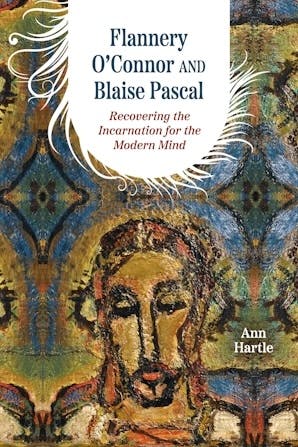
Ann Hartle, Flannery O’Connor and Blaise Pascal: Recovering the Incarnation for the Modern Mind (Washington, D.C.: The Catholic University of America Press, 2025), 196 pp. (pbk), ISBN 978-0813239729.
Ann Hartle is a U.S. scholar of the early modern French philosopher Michel de Montaigne and more generally, of philosophical modernity. Her latest book, Flannery O’Connor and Blaise Pascal: Recovering the Incarnation for the Modern Mind, addresses issues she has previously tackled (such as Montaigne’s dehumanized, disincarnate modern self), but also expands her scholarship to those two eponymous authors who—she holds—can be used adequately to engage and respond to Montaigne’s problematic modern worldview and theories. According to Hartle, O’Connor and Pascal’s shared awareness of modernity’s toxicity as well as their deep Catholic faith can help us respond and react to Montaigne’s self-centeredness and Gnosticism.
The book, in fact, seeks to answer a double question, “What does it mean to be Catholic in the modern world? What is the experience of the believer who wants to understand how faith might make sense of the human condition in a culture which is thoroughly secular and increasingly hostile to Christianity, and to Catholic faith in particular?” (p. 1) Blaise Pascal and Flannery O’Connor might seem like odd bedfellows to answer that double question, hailing not just from different centuries and countries (mid-17th century France vs. mid-20th century US South), diverse lines of work and literary genres (a philosopher-physicist-apologist vs. a short story, essay, and letter writer), but also distinct theologies (a Jansenist Augustinian vs. a “hillbilly Thomist”).
Happily, Hartle dispels from the outset any concerns about her team composition. If Flannery O’Connor illuminates the experience of the Catholic believer immersed in a toxic modernity through “her stories, letters, and essays” (loc. cit.), Blaise Pascal is a “truly Catholic modern philosopher who speaks to the experience of the searching mind of modern man. Pascal thus helps us to experience the meaning of O’Connor’s fiction from a philosophical perspective.” (p. 2) Hartle’s approach in this book is philosophical rather than literary, delving into O’Connor’s literary genius and concrete freakish characters to match Pascal’s more abstract theories.
What is the book’s intended audience? Simply, “the Catholic or the inquirer who seeks to gain a deeper understanding of what it means to live as a Catholic in the modern world.” (loc. cit.) This further requires, then, that Hartle make recourse not just to Pascal, as a paradigmatic Catholic modern philosopher and foil to Montaigne, but also to the Swiss psychologist Carl Jung for providing “the most comprehensive description of modern consciousness” (p. 3).
Hartle’s method, as she is careful to explain, is not to substitute O’Connor’s art with philosophical abstractions. Hartle notes that “O’Connor’s task as a novelist is to create the experience of the possibility of grace” (p. 4). On the other hand, Hartle describes her own goal as “to deepen the experience of the meaning of [O’Connor’s] stories by appealing to Pascal in order to uncover her Catholic assumptions, assumptions which are never stated in the stories but which give them their depth” (loc. cit.).
Hartle knows full well that O’Connor’s chief philosophical and theological authority was St. Thomas Aquinas, not Blaise Pascal. In particular, the Southern novelist drew heavily on Aquinas to combat the Gnosticism which she saw as rampant in modernity, leading “modern consciousness” to rest on the “spiritualization of the incarnation” (p. 6) of the Eternal Word of God in Jesus of Nazareth. But Hartle helpfully unites Aquinas and Pascal to fight modern Gnosticism—perhaps because, as a key footnote reminds the reader, “O’Connor is wary of what she perceives as Pascal’s Jansenism,” (n. 4, pp. 4-5).
Having explained why O’Connor’s freakish fundamentalist Protestant characters enable her to express sympathetically her Catholic views about both Christianity and modernity, Hartle describes the structure of her book. It comprises two main parts: “first, modern consciousness and second, the recovery of the incarnation—although both themes weave throughout the book” (p. 17). Thus, the book’s first four chapters use four of O’Connor’s best-known literary characters to establish and enlighten “the characteristics of the modern individual whose consciousness is unhistorical, solitary, and guilty.” The last three chapters comprising the second part then address “the recovery of the reality of the incarnation in O’Connor’s art, in the meaning of Christian conversion, and in the specifically Catholic response to contemporary culture” (loc. cit.).
Chapter 1, “The Idea and the Mummy: Hazel Motes’s Unhistorical Consciousness,” starts off by reminding the reader that all of us are deeply and irretrievably immersed in modernity’s woes—as O’Connor acknowledged about her own self. A first note of that predicament is what Jung identifies as our unhistorical approach, whereby we break with tradition in order to re-create ourselves, because we have spiritualized the incarnation by making a mere “idea” of what is effectively Christianity’s central mystery. This modern Gnosticism is visible in O’Connor’s first novel, Wise Blood, whose main character, Hazel Motes, is a paradigmatically modern man, constantly struggling against the “wise blood” that runs in his veins—a potent carnal symbol of the tradition he cannot overcome despite his best efforts. Motes’s idea(l) of a church with a purely human Jesus eventually founders on a mysterious mummy—symbolizing the typically modern division between the spiritual and the material. By contrast, argues Hartle, O’Connor’s “Christian Realism” founded on the dogma of the incarnation, like Pascal’s rebuttal of Montaigne, can help modern man reach salvation by returning to tradition.
In Chapter 2, “Hulga’s Heart Condition: The Disembodied and Detached Modern Mind,” Hartle focuses on the central female character in the short story “Good Country People” in order “to bring out more clearly O’Connor’s profound insight into the detachment and disembodiment of the modern mind, and [their] meaning for human life” (p. 45). Hulga, a self-renamed atheist and nihilist (olim Joy), will eventually realize, in the story’s moment of grace, that “she ain’t so smart.” As Hartle pithily puts it, Hulga’s tragedy is holding that all “experience is experiment” (p. 46). Thus, Montaigne’s division between mind and body, a consequence of his pervasive self-consciousness, makes for emptiness of the heart, which, by contrast, is a key symbol of Pascal’s Christian anthropology. Hartle shows how O’Connor chalks up our subsequent overarching psychologization to Jung, who professes to use religion but only really spiritualizes it to abstract symbols detached from reality. Our modern heartlessness is thus shown to be tragic.
Chapter 3, “Rayber’s Solitary Consciousness,” focuses on a character of O’Connor’s novel The Violent Bear It Away to illustrate Jung’s claim that “modern man is solitary ‘of necessity and at all times’” (p. 69)—a predicament traceable back to Montaigne’s self-obsessive subjectivity which excludes any and all life-giving alterity. Rayber, a psychologist, tries to reform his less enlightened kin, and especially his nephew, Tarwater. Rayber’s apparent coolness towards his own disabled son, Bishop, finds a tragic end when Tarwater drowns his cousin to death as he baptizes him. Hartle points out, however, that O’Connor’s tragic tones also disclose the possibility of grace and redemption for all concerned, provided they turn to genuine love and care for others, two attitudes all deeply hunger for but deny.
Chapter 4, “The Head-Doctor and The Misfit’s Guilty Conscience” tackles the antagonism between Freud and Jung’s approach to guilt and the Catholic doctrine of original sin. The short story “A Good Man Is Hard to Find” thus carefully crafts the character of the “Misfit” to show what consequences the denial of original sin can cause. In the story’s famous final face-off, the tedious Grandmother’s recognition of the Misfit as one of her own children triggers him to shoot her thrice, mercilessly. In typically O’Connorian fashion, the Misfit is a “prophet-freak,” whose refusal of grace reveals grace all the more clearly. Hartle brings in Pascal to show how inadequate premodern anthropologies, where man was at one with nature, are today, causing our freakishness’s inevitability. Hartle argues that we are all monsters and misfits now; original sin alone can make sense of what we are. This is especially true, she asserts, when stories like O’Connor’s make plain the mysteriousness of our condition, which can only be redeemed by the Christian mystery of the incarnation.
In a nutshell, the book’s first part asserts that modernity forces upon us self-centeredness, inner separation between body and soul, and a sense of being helplessly “lost in the cosmos” (to quote Walker Percy), of being misfits both in nature and in history. God’s grace, however, is always available to freaks—in fact, it is especially available to freaks!
In the book’s second part, Hartle offers a synthetic response, based on O’Connor and Pascal, to the predicament of the modern man. Chapter 5, “O’Connor’s Comic Art of the Possible and Pascal’s True Philosophy,” thus artfully brings together her art and his philosophy to underline how complementary their approaches are in answering our modern human predicament. O’Connor’s freak-show is better suited today than pre-modern approaches whose anthropological consistency no longer tracks. Thus, as Hartle pithily puts it, “Dante’s pilgrim becomes O’Connor’s prophet-freak” (p. 117). Calling on William F. Lynch SJ’s distinction between tragedy and comedy, Hartle shows why the comic streak of O’Connor’s incarnational, Christ-centered art is the most heartfelt, Catholic approach to our current condition. In fact, her stories, in their relation to reality, parallel patristic and medieval polysemic hermeneutics of Scripture, especially in providing a prophetic vision that always focuses “on the moment of possibility and decision”; to such end, “O’Connor recommends Pascal’s philosophy as preparation for […] the risk of the decision to follow Christ” (p. 127). In particular, Pascal’s wager, and the “nobility of unnaturalness” (p. 133) which he affords, are greatly helpful.
Chapter 6, “Conversion: From Modern Consciousness to Christian Consciousness” argues that the meaning of O’Connor’s stories always centers on the possibility of Christian conversion out of modernity’s woes. This is made more explicit by taking on three aspects of Pascal’s philosophy: “self-hatred and self-annihilation, the transcendence of the psychological, and the shifting of the center of consciousness from the self to Christ” (p. 139).
As a conclusion, Chapter 7, “The Misfit’s Prophetic Vision and Contemporary Culture,” returns to Hartle’s double opening question and quotes Romano Guardini’s standard for evaluating any epoch: “did it allow for the development of human dignity?” (p. 157) This chapter offers a dim, even bleak view of our post-Christian modern culture. Building on Guardini’s analysis of Pascal, it does not suggest returning to the Middle Ages, for that has been proven impossible. Instead, the clarity that culture and faith are indeed now divorced in modernity is seen as a gift, enabling us to see the paradigmatic evils of transhumanism and abortion. The solution, Hartle argues, is reconstructing incarnational spiritual relationships between the living, as well as in the Communion of Saints, especially through the Eucharist: “To see Christ in ordinary men and in ordinary bread is to see with the eyes of faith, to see the extraordinary in the most familiar” (p. 175).
This book is first to be commended for the originality of its approach to O’Connor. There is a plethora of books, blog posts, articles, and papers—whether academic or “middlebrow”—that deal with her writings from a literary and/or a theological angle. Hartle is to be commended for taking a philosophical one instead, and in particular, for picking one main philosopher, Pascal, to answer O’Connor’s queries about our common anthropological predicament, as we live through modernity.
The book is to be commended, secondly, for the sheer number and variety of quotations from O’Connor’s works—not just from some of her most beloved novels and short stories but also her letters and essays. Hartle’s mastery of the material is obvious and makes the book a solid possible introduction to O’Connor’s own thought, something nigh impossible if one sticks only to reading her stories. Likewise, Hartle extensively uses Pascal to support O’Connor in her critical dialogue with modernity, as well as Montaigne qua Pascal’s foil, and Jung qua paradigm of the “spiritualization of the incarnation.” Primary sources abound, as do secondary sources, ranging from Romano Guardini to Joseph Ratzinger to Josef Pieper, a great number of literary and theological O’Connor scholars, and other literati. By contrast, premodern authors like St. Anselm, Aquinas, or Dante are quoted to enhance, by contrast, particular aspects of modernity, such as loss of at-oneness with the cosmos and with history, or the separation between mind, body, and soul. At times, the number of secondary sources brought in to argue for Hartle’s theses based on O’Connor and Pascal could almost be overwhelming, but they are generally well integrated in the flow of her discourse.
Thirdly, Hartle’s main thesis is very clear, articulated around questions that are intelligibly indicated at the start and summoned again at the end. O’Connor’s literary characters are put to good use to explain Hartle’s critical view of modernity and they helpfully get explained by Pascal’s theories, either on their own, through analysis, or thanks to secondary literature that helps to thematize and expound on Pascal’s often terse material. The book is also rather short, which serves the author’s purpose. Some of her pithy slogans quoted above are very effective in conveying Hartle’s arguments.
Despite the book’s shortness, however, it does not avoid frequent repetition and constant weaving through of similar themes—as Hartle herself admits. Although the book’s approach is heavily philosophical as regards its themes, it is quite light in terms of formal argument. Thus, a lack of logical connectors throughout the book, leading to what may feel like a plain juxtaposition of sources, themes, and ideas, may frustrate those readers who are used to more formal arguing or a discourse that is more dynamic than static. Perhaps this can be explained by the author’s paradoxical approach: writing as an academic herself, likely for an academically-inclined audience, she also defends a salt-of-the-earth “felt-knowledge” of the heart rather than “thought-knowledge” of the mind (see p. 61)—this is not an easy circle to square, as anyone writing academically about literature knows too well.
As regards the book’s substance, some readers may also take exception to Hartle’s very grim views about modernity (especially including, but not limited to, Chapter 7) or her very definite and highly personal views about Montaigne. The advantage of partisanship is clarity; its disadvantage can be caricature. She pits Montaigne as Pascal’s chief foe (see p. 8), but of course, the latter also loathed the Jesuits—inter alia!—a fact she hardly mentions. Pascal and Aquinas are lumped together hastily when Hartle claims that “with respect to faith, both Aquinas and Pascal believe what the church teaches. Both express the eternal truth which cannot be captured fully in any system of thought” (p. 7). That is a rather controversial claim, to say the least. These aspects may make the book more suited for a first philosophical approach to O’Connor and Pascal in their embracing and rejecting of modernity and less suited for graduate research.
Still, the reader can thankfully take away what Hartle herself expressed, in an interview with her publisher, as her hope for this text: “a deeper and clearer understanding of the de-Christianized culture in which we live and the way in which the Catholic faith can be lived out in this culture. […] O’Connor shows us that […] conversion requires the confrontation with the modern consciousness that she saw in herself and portrayed in her characters.”
Nicolas Steeves, S..
Professor of Fundamental Theology
Pontifical Gregorian University
Rome, Italy

 Facebook
 Instagram
 Youtube
 X
X