The term “good” is used to indicate a standard of acceptability (i.e., that which is desirable) for any property or activity. Accordingly, the moral good is the criterion by which human actions are deemed desirable or worthy of choice. As the criterion for moral choice, the good represents the first principle of practical reasoning (ST I, q. 82, a. 1 and I–II, q. 90, a. 2). That is, it is the principle that informs thinking about what is to be done; for to call an act good is ultimately to justify morally the choice of that action.{1} That is, as the first principle, a notion of goodness is the self-evident foundation for all arguments: if an act is deemed good, deliberation about that act must cease since no one can reasonably question why one would desire the good as desirable and worthy of pursuit.
This role as the first principle for practical reasoning, however, leaves unanswered the critical question of precisely what the moral good is. Diverse definitions of the good will naturally lead to divergent systems of morality. For example, some will say that the good is the maximization of personal pleasure, a theory known as hedonism. On the other hand, some will say the moral good is that which God reveals to us in Scripture, a position known as divine voluntarism (or “divine command theory”). There can be very little agreement about particular moral issues among these people because their definitions of the good lead them to assess actions in incommensurable ways. Moreover, since the definition of the moral good is a first principle and the foundation for all arguments, the first principle itself cannot be established by argument. For this reason, arguments concerning the moral good must be conducted dialectically; that is, a certain definition of the good is granted, but then various objections or criticisms are brought forward concerning its cogency (ST I, q. 1, a. 8). In the end, the most adequate definition of the good is the one which that most fully the objections against it.{2}
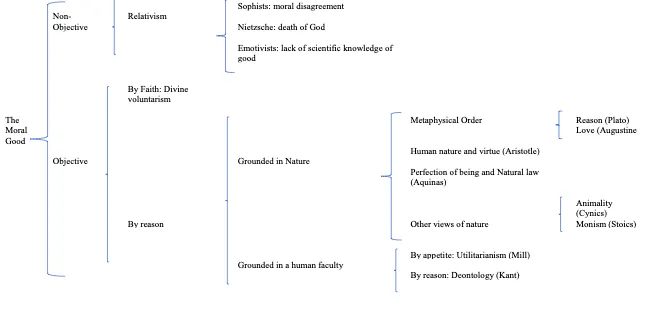
This article will outline some of the more significant definitions that have been offered for the moral good. This analysis will follow a series of fundamental disagreements about the nature of the moral good. First, I will take up those theories that deny that there is an objective definition of the moral good. Second, I will consider a theory that argues that there is an objective definition, though one not knowable by reason. Third, I will discuss theories that hold there is a universally knowable, objective definition of the moral good; but this can be divided into two distinct approaches. One approach sees the definition of the moral good as grounded in the objective metaphysical principles of reality. The other approach argues that this objective moral good is not rooted in nature but is rather determined by human evaluative assessments. It will be seen that the theory that grounds moral goodness in nature is most adequate because only then will the good be universally knowable as an objective standard for all people.
I. Relativism
The most fundamental question about the moral good is whether it is an objective fact. Indeed, the Bible’s presentation of the Fall of mankind can be understood as a rejection of the objective goodness decreed by God and a concomitant assertion that man can define the good for himself (Gn. 3:5; cf. Fides et ratio 22; Veritatis splendor 12 and 72). The contention that man defines the good for himself has recurred throughout the history of western philosophy. Because it claims that the definition of the moral good is relative to the perception of one making the judgment, it is called moral relativism.{3}
Moral relativism denies the objectivity of the moral good, and so each person (or culture) must define good for itself. The good, then, ultimately becomes a matter of taste or custom, and as such there can be no rational argument about various opinions about moral goodness. The appeal of moral relativism lies in the acknowledgment of the obvious fact that people in different times and different places have disagreed about what actions are good. This fact is taken to be evidence that there is no universal and objective definition of the moral good. Theories of moral relativism have been offered over the course of Western thought, from the Greeks to our own day. In fact, given the general moral disorder in contemporary society, Joseph Ratzinger said that today we live under a “dictatorship of relativism.”{4}
The basic structure of relativism is revealed in the debate between the Sophists and Socrates (470–399 BC) concerning the nature of morality. The Sophists, presented with the fact of moral disagreement, concluded that moral beliefs are simply a matter of custom (nomos).{5} As customary, these value judgments are simply an arbitrary assertion of the will of the people, reflecting whatever is desired at a given time. Since moral values would then be arbitrary customs, they can be changed according to variation in opinions. The clear consequence of this position is that there can be no objective definition of moral goodness since it is based on ephemeral preferences.
In response to this, Socrates argues that moral truths are not mere conventions but are a matter of nature (physis). Because moral truths are grounded in nature, they are objective, unchanging realities which can be discovered by reason. This gives moral values true significance, since now they are the standards that guide our will in decision making, instead of reflecting the will’s arbitrary tastes. The reason for moral disagreement lies in the failure of people to use reason well enough to discover the objective definition.
This line between custom and nature establishes the first major distinction in theories of the moral good: for the relativist, the moral good is arbitrarily determined by an act of choice; for everyone else, the moral good is a reality that can be rationally understood (though the nature of that reality is a matter of disagreement, as we will see). Thus, later recrudescences of relativism emphasized the arbitrary act of will as the basis of ethics, though the contexts for those arguments were distinct from that of the Sophists. Two of the more significant instances of this are those of Friedrich Nietzsche (1844–1900) and of the emotivists.{6}
Nietzsche’s philosophy was motivated by his antagonism to Plato and Christ, both of whom subordinate worldly human desires to a transcendent world of unchanging values. Nietzsche rejected this with his proclamation of the “Death of God.”{7} His intention was not simply atheistic; rather, his goal was to “erase the horizon” of all values, eliminating all moral frameworks, thereby freeing man to create values for himself. Since moral values are arbitrary, they arise from each person’s “will to power” to create one’s own values. The one who can do this is the “overman,” one who has overcome the illusion of objective morality that enslaved humanity during the Christian era.
Emotivism was widespread in the mid-twentieth century. It was inspired by a scientific worldview which claimed that statements are meaningful only if they are empirically provable. Clearly, however, the word “good” does not appear to indicate anything empirical. These thinkers concluded that “good” and “bad” are merely expressions of the speaker’s emotional reaction to something. To call something good is to say, “That pleases me. I like that”; to call something bad is to say it is displeasing. Whatever is good or bad remains a purely private judgment relative to any one person’s inscrutable feelings. Perhaps the most appalling fact about this theory is that it was one of the dominant schools in England as the West faced the Great Depression, the Second World War, the dawn of the nuclear age, and the Cold War. If the theory of the emotivists is true, then all of these great trials of moral analysis simply disappear into insignificance.
The position of relativism with respect to the moral good is highly flawed. First, the moral good is supposed to guide reasoning, but in refusing to offer a universal definition, moral relativists offer no reliable guide for practical reasoning. This undermines the very idea of the “good” as a standard by which to assess one’s own desires and actions. More obviously, relativism would have calamitous practical consequences, since if there is no universal definition of the good, no moral position can ever be criticized as bad, nor can anything be improved so as to be better. In the end, this makes human action unintelligible since there is no way to distinguish good and evil actions. Every action is equally appropriate for human beings, and so there is no reason to choose one as opposed to its opposite.
II. Divine Voluntarism
There is one historically significant position between relativism and objective philosophical notions of the moral good. This is divine voluntarism, which holds that the moral good is defined by God’s arbitrary will (voluntas in Latin). This is an advance over relativism because God’s declaration makes the moral law universally binding on all. However, problems arise concerning both the arbitrariness of God’s will as well as mankind’s ability to know this good apart from accepting revelation.
Since divine voluntarism holds that the good is not built into nature, it must be overlaid onto creation by God as an arbitrary standard people must adhere to. But this means, first, that God is always free to change those laws; there is no intrinsic logic about why we should not murder or steal.{8} Therefore, second, the only way we can know what God wants of us is by means of a revelation embodied in a religious tradition. One consequence of this is that we cannot reasonably expect people outside of that religious tradition to know and adhere to the moral law. For this reason, divine voluntarism ends up looking very much like a relativism: the moral good would apply only to those people who accept the religious tradition, and those outside the tradition are left to define good according to their own traditions.
There are two powerful reasons to reject divine voluntarism, one theological and one philosophical. Theologically, it is clear that the Ten Commandments are not a set of arbitrary rules that God imposes on believers to test their fidelity. Indeed, from the earliest chapters of Scripture, the standard of moral goodness was already understood to be universally knowable. For example, the stories of Cain and Abel, Noah, and Sodom and Gomorrah all depend on the fact that sin is known to be wrong. For this reason, one cannot see the giving of the Commandments as a revelation of an otherwise unknown moral code.
Philosophically, Plato shows that the notion of good as a standard applies even to God. In the Euthyphro, he poses the problem this way: Is something good because it is loved by the gods, or is it loved by the gods because it is good?{9} The former would condemn goodness to being based on arbitrary desire and make all moral theories relativistic (even when based on the arbitrary will of God, for God could always change His mind). The latter, though, sees the good as a standard grounded in nature which elicits desire because it is good. Plato’s logic can be applied to the Ten Commandments. Murder is not wrong because God prohibited it; rather, God prohibited it because it is wrong in itself. The metaphysical premise behind this is that there is a moral order built into creation; that order is the natural law. God’s Commandments are simply reminders of what we ought to have learned from reason about what is good and evil.{10}
III. Moral Good as Objective
A. Classical Background
If the good is to function as a basis for practical reasoning and is to be a common standard for all people, the definition of the moral good cannot change over time nor can it vary from person to person (or culture to culture). This was the insight that motivated Socrates to ground the good in nature and in reason in opposition to those who tried to redefine morality to fit the changing times.
Socrates’ position was influentially developed by his disciple Plato (427–347 BC). Plato saw that if the good is to be the universal standard Socrates sought, then it had to be not only a part of nature. Rather, it had to be the most important aspect of reality. As he puts it: “The greatest thing to learn is the idea of Good by reference to which just things and all the rest become useful…. [Do] you think there is any profit on possessing everything except that which is Good? Do you think it’s any use to us to own all there is and yet not own anything Good? Or to be wise in everything but the good, and have no wisdom about what is beautiful and Good?” (Rep. VI, 505a1–b3). Indeed, since the Good is a fundamental principle in the order of the universe, it must also be the standard for human behavior.
This insight is more fully developed by Plato in a series of arguments in which he specifies the relation of the Good to the rest of reality (Rep. VI–VII, 505–18). First, he draws an analogy between the physical world of material objects and the metaphysical world of forms. He observes that just as the sun provides the light which makes objects visible, so “the idea of Good…[is] the cause of knowledge and of truth in so far as known.” He further explains that the Good is the cause of the forms’ “very existence and essence…though the Good…transcends essence in dignity and surpassing power.” The Good, then, can be said to be the “form of forms,” the cause of the being and order of the universe. This conception is reiterated in the Simile of the Line and the Allegory of the Cave, wherein the Good presides over reality as the cause of the existence of the Platonic forms as well as man’s ability to know them as universal, unchanging truths. The moral good as an objective reality is determined in accordance with this, so that knowledge of the form of the Good will guarantee that one acts correctly. This is the basis for justice, or moral goodness. Knowing the good correlates with a well-ordered soul in which reason uses the emotions to control the appetites. Since there is a transcendent cause of the order of the universe, and that cause is the common essence of all instances of the good, relativism is both a sign of ignorance and of a diseased and disordered soul. One can attain happiness, then, only by adhering to the predetermined order of reality; indeed, to follow one’s desires against this order can only lead to the most wretched life since one is futilely trying to act against the laws of nature (Rep. IX).
Plato’s argument that the moral good is part of a larger metaphysics of natural goodness is a powerful response to moral relativists. However, the direct relevance of a transcendent form of goodness to the moral life is not precisely clear. This criticism is the starting point for Aristotle’s (384–322 BC) interpretation of the moral good: “Even if there is some one good which is universally predicable of goods or is capable of separate and independent existence, clearly it could not be achieved or attained by man; but we are now seeking something attainable…. It is hard, too, to see how a weaver or a carpenter will be benefited in regard to his own craft by knowing this ‘good itself,’ or how the man who has viewed the Idea itself will be a better doctor or general thereby” (Nic. Eth. 1.6, 1096b33–1097a11). Aristotle’s consistent reaction to Plato is to make his theory more worldly by immanentizing causes and finding in nature a potency for the changes that happen. In ethics, this takes the form of defining the moral good in terms of a rational nature’s potential to perfect oneself by developing virtue. This restriction of moral goodness to human agency yields a more determinate vision of the good life in which good actions lead man to happiness.
Aristotle understands that human beings have a great many reasons to act, for each action aims at some good: “Every art and every inquiry, and similarly every action and pursuit, is thought to aim at some good; and for this reason the good has rightly been declared to be that at which all things aim” (Nic. Eth. I.1, 1094a1–3). For example, a doctor uses medicine to cure sickness, a general uses strategy to win battles, a student reads to grow in knowledge of a subject. There is, built into the nature of any action, an end state that is understood to be the goal of the action, and that goal is the criterion of goodness. This is an application of Aristotle’s notion of final causality: every nature is defined by particular purposes for which it exists, and so there is a natural tendency for any nature to actualize a potency to attain that state of being which is its perfection. Thus, we judge an apple tree to be good if it is abundant with many edible apples. So, augmenting Plato’s response to relativism, Aristotle insists it is not our desire that makes something good, but rather, it is the case that we desire to attain some state of being because it is the perfection aimed at by the nature or by the action.
But Aristotle sees that there must be one supreme good which lends significance to all these other actions, or else everything we do is pointless. For example, in the course of a day we work, exercise, pray, play, and so on; but there has to be some reason why we engage in all these activities, i.e., some goal that justifies why we spend time doing these things. This supreme good must have two characteristics (Nic. Eth. I.7, 1097a15–b20): it must be an end-in-itself (that is, it is not chosen as a means to something else); and it must be self-sufficient, so that nothing else is needed or wanted in addition to it. For this reason, popular ideas of the supreme good—money, wealth, power, fame—fail, for each of these is either a means or something to which other goods could be added to make life better. The only thing that is truly an end in itself and self-sufficient is happiness (eudaimonia).{11} We do all things to be happy, and happiness is self-sufficient; for if one is happy, one is completely satisfied with life.
It is easy to see how this idea of happiness as a final cause can function as the first principle in practical reasoning. Since it is the state of being that is the goal of every person from the moment of conception, it motivates all decisions in the course of one’s life. It is also therefore the final answer explaining why we did something: because I want to be happy. This principle is self-evident, for if someone were to question why he should want to be happy, it would be clear that he did not understand the meaning of the word at all.
The major difficulty, however, lies in discerning what comprises happiness. Aristotle, invoking his understanding of the human soul as form of the body, defined happiness in terms of human nature and its essential function (Nic. Eth. I.7, 1097b21–1098a18). A good flute player plays music well; a good doctor heals well. But simply as human, man is defined by reason; hence, a good man is one who is rational. Happiness, then, lies in being rational in the most excellent way. In other words, happiness is a rational activity of the soul in accord with virtue (Nic. Eth. I.7, 1098a16–18, and I.13, 1102a5–6).
Virtue leads to happiness by perfecting two different powers of the soul according to the order of reason. Since moral actions are those which are consciously chosen, and choice is the result of deliberated desire (i.e., thinking about the various things I desire) (Nic. Eth. III.2 and VI.2), then good moral choices must perfect both the appetites and the reason. We need to desire the right end, since if we do not want the right thing there is little chance we will do it; but what that right end is must be determined by right reason. The appetitive power is perfected by moral virtues. Moral virtues shape our animal desires concerning pleasures and pains by forming a habit of desiring the right thing in the right way. This habit is formed by repeating an action to inculcate a disposition, or a state of character, to feel and act according to a mean between excess and defect—neither too much nor too little—with respect to pleasures and pains. Moral virtue is necessary because if those feelings are exaggerated, they obviously can lead us astray in making choices. Once this feeling becomes habitual, it is, in a telling idiom, a second nature perfecting human nature’s inborn tendencies.{12}
Since moral virtue depends on determining the mean between excess and defect, another sort of virtue is required by the rational power itself. This excellence in thinking is called intellectual virtue. Intellectual virtues (in contrast to moral virtues) can be taught, for training the intellect to think well is the object of education. However, since reason considers two kinds of truth, there are two categories of intellectual virtues (Nic. Eth. VI.1, 1139a3–15). Some truths are universal and unchanging (such as math and metaphysics), knowledge of which is made possible by the scientific intellect (or, as it will be known in the later tradition, the speculative intellect). There are three virtues that help perfect this kind of thinking. Understanding is the ability to intuit the first principles or self-evident bases for arguments in a particular area. Science is the ability to make arguments from those principles to further conclusions. Philosophical wisdom is the ability to know the highest first principles: those of metaphysics.
On the other hand, some truths are contingent or changeable. For example, if I ask a carpenter how to build a chair, the answer will depend on who it is for, what the budget is, what sort of room it will go in, and so on. Similarly, discerning the nature of courage depends on the person and situation at hand; a soldier and a civilian are expected to act in different ways. This sort of reasoning about changeable truths is an activity of what is known as the calculative intellect (or, as the later tradition will call it, the practical intellect) since it requires adapting the judgment to the concrete circumstances. There are two virtues to perfect this kind of thinking. Art is the virtue of knowing how to make things well; practical wisdom (or prudence) is knowing how to act in a given situation to attain the moral good. This is critical for ethics since prudence is the “reasoned and true state of capacity to act with regard to human goods” (Nic. Eth. VI.5, 1140b20–21). Prudence is the capacity to grasp the true good for a human being in a given circumstance (that which ought to be desired in order to attain happiness). For this reason, prudence is the foundation for the moral virtues, for it grasps the mean to be aimed at as the best way to feel and act.
Although prudence is fundamental, it is not sufficient for human happiness. For if happiness lies in reason, it must lie in the highest use of reason. This is philosophical wisdom, by which we know the highest causes of reality. Prudence, though, is necessary as the means by which philosophical wisdom can come into being.{13} A man cannot engage in philosophical contemplation so long as his desires are not controlled. Therefore, we first need prudence to create in us the habits of moral virtue; but once these desires are controlled, the mind is free to pursue the highest goods.
It is now clear how virtues are the necessary means to attain the ontological state of perfection we call happiness. Human nature is rational, with a potential to grow in rationality. This process of development has two poles. The first pole is that of moral virtue, by which the prudent man moderates desires and emotions according to reason so that his activity is not controlled by irrational factors, especially the desire for pleasure. The second pole is the development of the rational power itself, so that it can attain its highest function: metaphysical contemplation of the highest cause. This contemplation is the ultimate goal for man because it is an end in itself and self-sufficient (Nic. Eth. X.7, 1177a18–b6). As the state of perfection for human beings, it is the reason everything else is done, including political activities, which guarantee peace and justice as the social conditions which make contemplation possible (Nic. Eth. X.9).
Aristotle took up Plato’s quest for an idea of the moral good rooted in objective reality. He improved upon Plato, however, by making that good a particular object of desire in this world, something attainable through the actualization of the potential of human nature. On the other hand, by eschewing Plato’s vision of a transcendent Good, Aristotle does introduce a vulnerability into his theory. Since the perfection of being is purely temporal, there is no sense of real obligation; there is no authority to whom man is responsible in his moral choice other than himself. Thus, there is a need to combine Aristotle’s idea of the moral good as the perfective action of a nature in terms of its final cause with Plato’s idea of the Good as the metaphysical order of the universe. This is precisely the approach taken by St. Thomas Aquinas; as he puts it, “Everything is…called good from the divine goodness, as from the first exemplary, effective, and final principle of all goodness. Nevertheless, everything is called good by reason of the similitude of the divine goodness belonging to it, which is formally its own goodness, whereby it is denominated good. And so of all things there is one goodness, and yet many goodnesses” (ST I, q. 6, a. 4). Elucidating this argument will bring out the clear connection between the metaphysical order of creation and moral goodness as sought by man.
Let us first briefly note a few other classical notions of the moral good which exercise influence in subsequent philosophies. There were other Socratic schools which identified the good with nature but, unlike Plato and Aristotle, did not define nature according to human rationality. These are important because contemporary invocations of nature as a standard are subject to these same ambiguities. At one extreme are the Cynics, who identified nature with our animality. Consequently, they argued that happiness arises from following our animal instincts without regard to social strictures. This shamelessness led Plato to call the founder of Cynicism, Diogenes of Sinope (d. ca. 321 BC), “a Socrates gone mad.”
A more reasonable approach was that of the Stoics, who again identified the good with following nature but, in place of the plurality of natures posited by Aristotle, argued that the entire cosmos was one nature. The causal principle for the cosmos is a sort of divine mind which orders all things with necessity. This cosmic order is a sort of natural law. Because humans are rational, we have a spark of the divine, thereby allowing us to understand that order and act in accord with it. Thus, acting according to nature, law, and reason all coincide as a standard of moral action. However, the unavoidable consequence of this is that the causal system of nature is completely inescapable, resulting in a determinism. As a result, the reason of a virtuous person aims to suppress all emotion and desire and simply accept what fate has ordained, since what is ordained by the cosmos is the definition of the good.
Finally, while Christianity brought forth epochal changes in the ancient world, its early philosophical investigations absorbed much of the Greek tradition of virtue. St. Augustine (354–430 AD) introduced the most significant innovations to this, and it was his adaptation of Platonism that would be the foundation for Western Christian philosophy for almost one thousand years. First, he took up Plato’s idea of a transcendent source of order and criterion of goodness, but instead of an impersonal philosophical principle, Augustine identifies this with the personal God of Christianity who creates out of a gratuitous love. Second, in place of Plato’s insistence that knowing the good will lead to doing the good, Augustine realized that knowing the good does not guarantee that one will do the good. Therefore, he developed the notion of a free will so that man must choose to act in accord with the natural order. The order of nature that constitutes the moral good is the Eternal Law, that by which reality is ordered. We fulfill this order not simply in knowing it, but in loving things according to their natural order. Most importantly, we should love eternal things, especially God, more than any temporal creature. This is the only way to attain happiness, since while we can never be deprived of an unchanging God so long as we love Him, creatures can change, so loving them risks losing the object of one’s love, leading to unhappiness. Augustine thus famously summarized his idea of the moral good: “For Thou hast made us for Thyself and our hearts are restless till they rest in Thee.”{14} An important corollary to this is that evil is the result of a disordered love, where we desire something that cannot bring us lasting happiness. Augustine, therefore, connects human moral goodness in the act of love with the transcendent ontological goodness of God Who creates all out of love.
A. The Synthesis of St. Thomas Aquinas
Thomas Aquinas (1225–1274) goes beyond Plato and Aristotle in defending the objectivity of the moral good because he identifies the good with being itself. The source for this is the revealed truth that in the act of creation God shares the goodness of existence with creatures (Gn 1). Thus, the good is not identified simply with a transcendent cause of order, nor with an immanent cause of change, nor with the feelings or thoughts of man; rather, it is identified with the most common metaphysical principle—being (or esse) as the act of existence—and so integrates all those perspectives into a coherent whole. Accordingly, when Thomas defines the first principle of moral reasoning as “do good and avoid evil” (ST I, q. 79, a. 12 and I–II, q. 94, a. 2), this almost tautological statement carries profound implications in light of the way in which the good has been developed as a metaphysical principle defined in accordance with the analogy of being.
The key to Thomas’s argument is his notion that the act of existence is the act of all acts and so the perfection of all perfections (De potentia, q. 7, a. 2, ad 9). All created beings, both substances and all their accidents, are contingent: they do not have to exist. That they exist at all is due to a causal principle extrinsic to them, and this is the act of existence (De ente et essentia, c. 4). Moreover, this causal principle can only issue from a being whose essence is existence, thus pointing to God’s perfect being and perfect goodness as the source of all contingent being (ST I, q. 3, a. 4; I, q. 44, a. 1; I, q. 65, a. 1, and De potentia, q. 7, a. 2). Thus, existence is the metaphysical actualization of all potencies; in other words, it is a realization or perfection of those potencies. Further, as a perfection, it is desirable, and the good is what all things desire. Thomas makes this clear in his defining good as convertible with being: “Now it is clear that a thing is desirable only in so far as it is perfect; for all desire their own perfection. But everything is perfect so far as it is actual. Therefore it is clear that a thing is perfect so far as it exists; for it is existence that makes all things actual…. Hence, it is clear that goodness and being are the same really. But goodness presents the aspect of desirableness” (ST I, q. 5, a. 1). We can conclude, then, that, for Thomas, the good is the perfection of being.{15}
This claim, though, brings an immediate objection: if good is the perfection of being, it must be the case that every existing thing is good. On the one hand, this would support the revealed truth that in creation God makes every creature to be good; on the other hand, however, it contradicts common experience since the experience of evil—sickness, sin, disaster—is the most agonizing fact of the human condition. Thomas resolves this apparent dilemma by reference to the distinction between first actuality—the existence of natural substances in the world—and second actuality—attaining the final cause which is the end for which that substance exists. Each of these modes of being has a distinct mode of goodness:
A thing is… said simply to have being, accordingly as it is primarily distinguished from that which is only in potentiality; and this is precisely each thing's substantial being. Hence by its substantial being, everything is said to have being simply; but by any further actuality it is said to have being relatively…. But goodness signifies perfection which is desirable; and consequently of ultimate perfection. Hence that which has ultimate perfection is said to be simply good; but that which has not the ultimate perfection it ought to have (although, in so far as it is at all actual, it has some perfection), is not said to be perfect simply nor good simply, but only relatively. (ST I, q. 5, 1, ad 1)Thus, while we can affirm the metaphysical goodness of everything that exists because it ultimately comes from God, complete goodness is achieved when the substance realizes its potential for the operation for which God created it. Indeed, Thomas is clear that the very existence of forms is for the sake of that operation: “All things created would seem, in a way, to be purposeless, if they lacked an operation proper to them; since the purpose of everything is its operation. For the less perfect is always for the sake of the more perfect…so the form which is the first act, is for the sake of its operation, which is the second act; and thus operation is the end of the creature” (ST I, q. 105, a. 5; cf. SCG III, ch. 113.1).
The analogical nature of being is correlative with an analogical notion of goodness. For this reason, we can affirm the apparently paradoxical fact that everything is good, but some things are better than others. Because good is a transcendental property convertible with being, everything must be good. However, because all creatures are created by God with a potency to act for their own perfection, then some apple trees are good, and some not; some men are good, and some are not. This second mode of goodness is not a transcendental property since it does not belong to all creatures; rather, since it only belongs to some creatures, it is a division of being, namely, an accident of quality (De veritate, q. 21, a. 2, ad 6). This insight on the analogical nature of goodness rests on a profound sensitivity to the act of existence which comes from God to make all things real, both first act and second act. In this way, Thomas synthesizes Plato’s insistence on a transcendent and perfect source of goodness with Aristotle’s insight into the dynamism of nature as defined by final causality. Moreover, synthesizing the Greeks with St. Augustine, he can also point out that the more being (second act) a substance has, the better it is; and the better it is, the closer it is to God, who is Being and Goodness itself (ST I, q. 6, a. 1).
Thomas’s philosophy assimilates metaphysical goodness with moral goodness on the bases of two complementary metaphysical insights. From the perspective of the natural causal order, forms are associated with final causality. And whatever comes into being through the proper operation of a substance is good because it is the desired end of that substance’s existence (SCG III, ch. 25.3).
In addition to this purely natural explanation for the obligation to pursue the good, there is a more profound supernatural explanation. This is the fact that God as Creator gives the act of existence but also exercises divine providence over His creatures. Thomas explains providence in this way: “In created things good is found not only as regards their substance, but also as regards their order towards an end…. Since, however, God is the cause of things by His intellect…it is necessary that the type of the order of things towards their end should pre-exist in the divine mind” (ST I, q. 22, a. 1). God endows creatures with the dynamism of the act of existence so that they might attain the end for which He created them. The obligation of creatures to attain their end is therefore reaffirmed but reinforced in terms of an obligation to a supernatural standard of activity, providence, which orders all creatures to the perfection of the universe. This sense of obligation is brought out in the fact that the providential order is also called, reminiscent of Augustine, the eternal law—the rational order by which God directs activity in the universe for the sake of the universal good (ST I–II, q. 91, a. 1). It is man’s knowledge of the eternal law’s ordering of creation that is the basis for the natural law, for in knowing the perfective end of human nature we can also know what is necessary to attain it (ST I–II, q. 91, a. 2).
This metaphysical context provides the foundation for Thomas’s concept of the moral good. All creatures, then, are ordered to the perfection of being; they naturally seek the good. But the act of existence is received into a determinate essence given each creature’s specific mode of being, or nature. Since nature is an internal principle of development, there is a determinate pattern of development and change{16} that is required to attain the complete goodness manifested in the substance’s operation. To understand moral goodness, therefore, we must first understand human nature and then what must be done to bring perfection to that mode of being.
This orientation to moral good as the perfection of being is made difficult, however, because human nature is complex—we are rational animals. This means that we have many activities that in one way or another are constitutive aspects of human perfection, even if they are not the ultimate purpose for which humanity exists. As living beings, we have vegetative powers with the capacity to assimilate nutrition and hydration, as well as a power to reproduce. As animals, we have sensitive powers which endow us with instinctive desires and emotional reactions for material goods that allow us to survive and have pleasure. As rational creatures, though, we are possessed of intellectual cognition, which allows us to understand the world as it is in itself and not merely as it appears to us in terms of our biological imperatives. We also have, correspondingly, a rational appetite that seeks not only particular desirable objects but the complete perfection of human nature in terms of that which is truly good in itself.
To illustrate the significance of these rational powers, let us consider a simple act of choice: should I get out of bed? When the alarm goes off, a first impulse is to hit the snooze button to get ten more minutes of sleep. This reflects the very real goodness of sleep for us in terms of our animality. Similarly, I might want to get up and eat—another biological imperative. But I know that in order to keep healthy, I need regular exercise, so I override those biological imperatives in favor of working out. However, as a rational being, I am aware that there is something higher even than bodily health: the health of my soul. Consequently, I see that I should get up and pray, since this is the most important need that can be met. It is the highest good since it most fully perfects human nature. Although sleep, food, exercise, and prayer are all individual goods, one cannot have them simultaneously. Thus, the act of moral choice is to determine which of the many particular goods that I desire is the best thing at this time.
Like his predecessors, Thomas will refer to the highest good, the ultimate goal of human existence and the end to which all actions are subordinated, as happiness (ST I–II, q. 1, a. 4–7). Thomas’s idea of happiness is similar to Aristotle’s: it is the fulfillment of human nature’s characteristic potential as rational. But Thomas integrates Aristotle with Augustine, for happiness is not only perfecting the intellect in possessing the highest truths, but also perfecting the will in loving the highest good. Because this absolute Truth and absolute Good cannot be found in any finite creature, happiness is found only in union with God (ST I–II, q. 2, a. 8 and I–II, q. 3, a. 8). However, because we do not have direct access to God in this world, we have to exercise choice among the finite goods available to us, as illustrated above, so as to bring us as much truth and goodness as possible. For this reason, some acts are by nature more fulfilling than others: acts ordered to higher truths and greater goods are more noble; they fulfill our potential more fully and so ought to be chosen over other acts.
Since choice involves the whole person’s good, it can be reduced neither to following the appetites nor to obeying abstract rational laws. Rather, choice is a deliberated desire: a complex interplay of reasoning about our inclinations to discern which is best (ST I–II, q. 6–17). A good choice results in an act{17} that is fully rational (ST I–II, q. 18.1). Indeed, when the will refuses to follow reason and opts for a lesser good, this is a rejection of both human nature and providence because it deprives us of our natural operation, and so is evil (ST I–II, q. 71, a. 2).
As noted above, the complexity of human nature endows us with desires and emotions that might impede making a fully rational choice.{18} For this reason, determining the most rational act is difficult. Therefore, there are certain aids, both intrinsic and extrinsic, built into creation to assist man in making good moral choices (ST I–II, q. 49, proem. and I–II, q. 90. proem). One intrinsic aid is our natural inclinations, which order us to happiness. Our nature is not morally neutral but is inclined to the good because we desire the perfection—happiness—that comes with being fully rational. Further, while we have subrational inclinations associated with our animal nature, we can perfect these inclinations by subordinating them to reason in the development of virtue (about which Thomas largely follows Aristotle, with the important addition of the theological virtues of faith, hope, and love (ST I–II, q. 62, a. 1–4). The extrinsic aids are law and grace, both of which are given to help people lacking in virtue to know what ought to be done.{19} Laws are rational directives pointing out what is necessary for happiness in terms of the concrete conditions of human nature. Grace, by contrast, is a supernatural gift whereby man is elevated into a participation in the life of the Trinity, thus animating us with an anticipation of the complete and eternal happiness that is our ultimate end. These extrinsic aids thereby make known standards for action which allow us to develop virtue, for they contain the standard of rationality and moral goodness. Thus, the natural law is the foundation for virtue since “all acts of virtue are prescribed by the natural law” (ST I–II, q. 94, a. 3). The crucial truths for perfecting human nature in moral goodness are contained in the precepts of the natural law.
The purpose of law is to serve as a measure of our actions insofar as those actions are necessary or conducive to happiness. Since man’s happiness is the fulfillment of his rational potency, Thomas defines law as an ordinance of reason for the common good promulgated by the proper authority.{20} The characteristics in this definition assure that law is inherently in service to the moral good, the perfection of being insofar as a human being is rational. Our participation in the order of law perfects our nature because it perfects our rationality, our capacity to know the order of reality and to choose according to the proper order of love. This is evident in the following analysis of the defining elements of law.
As an ordinance of reason, law must accord with the truth, with reality as it actually is. Thus, it directs man to be rational in adhering to that truth. This distinguishes a true law from a mere act of will—a positivist notion of law where the mighty (be it in a despot or in an elected legislative majority) have the power to enforce preferences. Because law must accord with the metaphysical nature of the good, there can be laws that are unjust and so which lack moral authority to be obeyed. Recognizing that unjust laws ought to be changed indicates the necessity of an order of justice above human society. This is the natural law: a rational order which should direct all our legislations.{21}
The law is also for the common good. This again points to the metaphysical foundation for morality, since human beings share a common nature and so necessarily share the same end: happiness. But this happiness lies in fulfilling our rational potential: to know truth and to love the good. But knowing and loving are inherently interpersonal actions—we learn in dialogue with others, and we grow in love in friendship with others. For this reason, law must be oriented to the common good of a community and not the private good of a few.
Law must also be promulgated by the proper authority. Since law orders a community, the distinction of communities allows us to discern four general kinds of law which order human life in different ways (ST I–II, q. 91). The largest community we belong to is that of creation. God, by His providential reason, orders the universe to the common good of all creation. This is the eternal law which directs the activities of all creatures by inclining all natures to act for a final cause. Second is the community of man. While man is subject to the eternal law’s direction to the good (i.e., we are naturally inclined to happiness), we can also know this order by reason. This rational grasp of the order of nature allows man to be “provident both for itself and for others.”{22} This is the natural law. In other words, knowing the natural law allows us to know the ontological goodness for humankind and the entire universe and to act so as to bring the providential order of creation to completion. Third are particular human communities—nations, cities, schools, clubs, corporations, etc.—which need to make rules to order a group’s behavior for the common good. These are human laws (or positive laws). Finally, there is the community of the Church, the people called by God and covenanted to Him. This is reflected in the revealed laws given by the authority of Scripture to Jews and Christians. This is the divine law, a gift of grace which goes beyond worldly happiness by revealing what is necessary for salvation.
Thus, we find in the natural law precepts which direct man to the perfection of his being, and which are known to us as rules for moral goodness leading to happiness. The precepts fall into three levels of increasing specificity: the primary precepts, which are self-evident and so known by all people; the secondary precepts, or immediate conclusions from the primary precepts, which are general rules known to most people (though passion or vice may obscure knowledge of them); and the tertiary precepts, or applications of the secondary precepts to a concrete instance, which can be difficult and so require prudence (ST I–II, q. 100, a. 1, 3, and 11). Since the more detailed precepts are derived logically from the primary precepts, they should not be understood as a multitude of discrete rules that must be obeyed legalistically; rather, the more detailed precepts only specify what is already contained in the general ones, providing the particular details about what is necessary to perfect human nature.
As mentioned earlier, the concept of the moral good provides the first principle of practical reason, that is, as a self-evident basis for thinking about what one ought to do. Because Thomas has identified the good with the perfection of being in terms of the act of existence, he will denominate his first principle as a corollary to speculative reason’s first principle of non-contradiction (ST I–II, q. 94, a. 2). While truth points to the stability of substantial being (first act), good points to the dynamism of attaining second act as the perfection of potency.{23} This self-evident principle, then, directs all practical reasoning because it points out the goal of our acting. We have already seen that all action, as directed to fulfilling a tendency to perfection, aims at a good that is desired. The first precept of the natural law reflects this as the most general rule about acting: “good is to be done and pursued, and evil is to be avoided.” This simply indicates why action exists, a point about which it is impossible to be ignorant since we always desire the good as the perfection of being.
However, we must apply this to human nature. These precepts are self-evident so long as one knows what human nature is, for we can see that the natural inclinations of man indicate what is good for him. Since action follows from being, these inclinations reflect man’s essence as existent, as animal, and as rational.
First, simply as existent, we have an inclination (shared with all beings) to preserve the good of our existence. Second, as an animal, we have inclinations to preserve the species by reproducing and raising offspring. Third, as rational, our specifically human good is to perfect rationality in wisdom and love. But learning and loving are only possible in communion with other people, and in conversation and friendship; thus, the precept specifically declares that we must form society with other men and strive to know God as the highest object of knowledge and love.{24}
Yet these precepts—“live in society” and “love God”—are extremely vague. For true moral direction, we need more concrete rules telling us how to love God and how to live in society. This is the role of the secondary precepts which, as “immediate conclusions” from the primary precepts, are easily inferred as necessary conditions to realizing social order and love of God. Even though these rules are not self-evident, as the most general moral precepts they are fairly obvious and broadly known. These precepts are often identified with the Decalogue. The First Table indicates what is necessary to do for our relationship with God, and the Second Tablet provides details for how to live justly with our neighbor (ST II–II, q. 122). Following these rules enables a person to form proper relationships with other people and with God, thereby satisfying man’s inherent desire for truth and love.
Nevertheless, these precepts still need to be applied to concrete situations. These applications constitute the tertiary precepts of the natural law. We know we should not steal, but what counts as stealing is not always obvious. To take something you need to save a life does not count as stealing (ST II–II, q. 66, a. 7). Similarly, not all killing is murder; self-defense and just war are instances of licit killing. But since it is not always easy to make these judgments, the virtue of prudence is required to know how a law applies in a particular instance. The more specific the situation, the more prudence is needed, for there will be more exceptions and a greater likelihood that vice or passion will distort one’s judgment (ST I–II, q. 94, a. 4–6).
In sum, the precepts of the natural law articulate the relationship between moral and metaphysical goodness. Metaphysical goodness is the perfection of being. Moral goodness is man freely choosing to attain that perfection of being—happiness—in terms of perfecting his rational potential to know and to love. The moral good, then, is clearly rooted in the metaphysical order of nature. For this reason, the good truly is universal and unchanging, for as long as human nature is the good that man seeks will be the same. Modern philosophers, however, introduce certain assumptions that make this equation between metaphysical and moral goodness difficult to maintain; they will nevertheless insist that there can still be an objective idea of the moral good.
B. Objective, but Non-Natural
The metaphysical tradition of associating being and goodness was challenged with the rise of modern philosophy. The main culprit in this is the widespread assumption of nominalism (the denial of the reality of universal natures), which affects our understanding of goodness in several ways. First and most obviously, the denial of natures entails the denial of teleology: if everything is radically singular, then there is no regular pattern of behavior that follows from the nature of the substance. Thus, the good cannot be identified with a final cause indicating the perfection of potential. Second, being itself cannot denote any common property that unites all existing things. In place of Thomas’s act of existence as a universal causal principle, philosophers now think of existence as a brute fact that simply posits something as real. Thus, the good cannot be the perfection of being since existence itself is not an act of perfection at all. The unavoidable consequence of this severing of being and goodness is that moral goodness becomes a quality that man must determine for himself. And since there are two reasons for acting at all—we do something because we want to (desire) or because we think we should (reason)—the good in modern moral philosophy will be seen to be derived from value judgments arising either from man’s appetite or by his reason.
This anti-metaphysical assumption finds its clearest articulation in David Hume’s (1711–1776) Fact-Value Dichotomy (A Treatise of Human Nature, bk. 3, pt. 1, sect. 1). Hume argues that we cannot derive an ought (a value which motivates one to act) from an is (a fact in the world which in itself cannot motivate action). In other words, what a given state of affairs is cannot determine what is to be done; rather, what one does depends solely on one’s desires. For example, if four people see a donut on the table, they will readily agree to that fact; but what they do—whether to eat it oneself, to share it, to give it to someone next door, to discard it as bad for one’s nutrition—depends on what the person wants. For Hume, then, the good is defined wholly in terms of the satisfaction of desire, or pleasure: “All morality depends upon our sentiments; and when any action, or quality of the mind, pleases us after a certain manner, we say it is virtuous.”{25} Because the good is defined by desire, reason is relegated to a purely instrumental role; as he famously argues, “Reason is, and ought only to be the slave of the passions” (Treatise of Human Nature, bk. 2, pt. 3, sect. 3). We use reason simply to figure out how to get the things we desire; but the desires themselves are inscrutable: one never has to deliberate about whether a desire is itself good.{26}
The assumption that the good is not a fact of nature but instead must be determined by a value judgment underlies the two dominant schools of modern moral philosophy: utilitarianism and deontology. Both schools try to find a way to establish an objective criterion for the good which is not part of the order of nature. This leads both theories to consider goodness not as a quality of a moral person, but rather simply as an act that adheres to an abstract standard. Since people cannot be good, both theories encounter problems in explaining a motive for why one should act in conformity with that standard.
Utilitarianism was developed by Jeremy Bentham (1747–1832) and John Stuart Mill (1806–1873). Following Hume, utilitarianism argues that since desire for pleasure is the sole motive for action, pleasure is the only criterion by which to assess those actions. Although pleasure itself is a subjective experience, it can be an objective criterion for morality by insisting that it is not just an individual’s pleasure that matters (that would be hedonism), but rather the cumulative pleasure of all people. The good according to this theory is that which brings the greatest amount of pleasure for the greatest number of people. This is utilitarianism’s principle for moral reasoning: we should act to maximize pleasure and assess actions on the basis of how much pleasure was attained.
There are two aspects of utilitarianism that make it an appealing ethical theory. First, it recognizes the truth that man is motivated by his appetites, and that we naturally seek satisfaction of our desires. Second, it taps into the commonsense notion that ethical actions should benefit the majority of people—a common good—as opposed to a purely personal good. Unfortunately, the way in which utilitarianism pursues these ends also reduces moral goodness to atomistic experiences that make it difficult to frame a truly objective ethics.
The first significant problem is that since the moral goodness of an act is determined by the pleasure that results from it, it becomes impossible to explain why people should seek higher values—religion, patriotism, friendship, work—that are not always sources of pleasure. Mill tries to incorporate these into his calculus by saying that these follow from a sense of human dignity. That is, he seeks to include a consideration of the quality of a pleasure in addition to the sheer quantity of pleasure, insisting that people will prefer rational pleasure over sensual pleasure by virtue of their dignity. However, this is a self-refuting argument, for the use of dignity as a criterion contradicts the notion that pleasure is the sole criterion. (Indeed, dignity can be used as a criterion by Aristotle and Aquinas because they define the good in terms of rationality, not pleasure.) Second, there is simply no rational way to “count” pleasure and pain. In fact, since pleasure is a subjective feeling (as opposed to a universal rational concept) it is always private, and so it is simply impossible to judge the pleasure of the greatest number of people. Third, the need to maximize pleasure clearly accepts the logic that the end justifies the means; anything can be done so long as the consequences merit it. However, a corollary to this is that there can never be anything that is intrinsically good or intrinsically evil. One can renounce faith in God or friends if it brings about better consequences; one can kill an innocent child or steal at will so long as it leads to more pleasure. Finally, even utilitarianism’s emphasis on the common good is vitiated by the focus on pleasure. Since different people will find pleasure in greatly different activities, the common good is simply the sum total of individual pleasures—each person in his own corner playing his own game. There is nothing truly shared in this experience, so it is not a common reality at all. Moreover, what people find pleasurable will change over time, so morality itself has to readjust to the appetites of each generation.
Immanuel Kant (1724–1804) took Hume’s Fact-Value Dichotomy in the opposite direction. He begins with a forceful rejection of basing moral goodness on desire: ethics, he insists, is not about doing what you want; it is about doing what you have to do. This leads him to radically diminish the appetite’s relevance for ethics, and to argue instead that morality has to be based on reason alone. This is possible because desire is not the only motive for action. Reason can act as a motive insofar as man can recognize his duty to the moral law. When I recognize I ought to do something regardless of what I want to do, I am motivated by duty to the law. Moreover, since desire for pleasure is instinctive, man is not truly free in acting on it. On the other hand, when man acts on reason, he is truly free and so can be responsible for his actions.
We immediately see what makes Kant’s approach to ethics attractive. He grasps the importance of moral duty even when it conflicts with desire. Also, since this duty is grounded in reason, and not subjective appetites, it offers a truly objective criterion for action that everyone can know. While this approach is certainly more rigorous than utilitarianism, it nevertheless goes too far in the opposite direction. By completely isolating reason from desire, he ignores the incarnational truth of human nature. His theory reduces man to something like a disembodied intellect, and so this theory can never reflect the complete human good.
To appreciate Kant’s idea of the moral law, we need to understand how it draws explicitly on his theory of causality. Given the assumptions of nominalism shared by most modern philosophers, there is no assurance that natural objects will behave in predictable ways. From this, they conclude that there are no necessary causal relations in reality. However, this threatens science, which is based on universal and necessary relations of cause and effect. To save science, Kant argues that necessity is imposed on reality by logical judgments of the mind. That is, the mind has a priori logical structures which relate experiences to one another with a necessity characteristic of scientific law. This is directly relevant for ethics because, if morality is about what you have to do, it is about necessary moral laws. For these laws to be necessary, they cannot be based on experience (since there are no necessary relations in experience itself). For this reason, we cannot look to human nature or happiness as a basis for the moral laws. Rather, for Kant, they have to be based solely on abstract reason; they are binding because these are willed according to reason, not because they reflect nature. But a law that cannot be about any empirical fact can only be about acting purely rationally, that is acting in a necessary and law-like way: “Since I have deprived the will of every impulse that could arise for it from obeying some law, nothing is left but the conformity of action as such with universal law, which alone is to serve the will as its principle, that is, I ought never to act except in such a way that I would also will that my maxim should become a universal law” (Groundwork of the Metaphysics of Morals, sect. 1, 402, emphasis original). Kant calls this a priori law of morality the categorical imperative.
The moral good for Kant is conforming with this law that requires that an action be universalizable: if an act can be done by everyone without any contradiction, then the action can be a law. For example, if I want to steal someone’s car, then I make all car theft universally allowable; but that leads to a contradiction, since as soon as I steal the car, someone can steal it from me. It is contradictory because although I aim to possess a car, I end up depriving myself of it. The moral good, then, is the rational consistency of a universal moral law.
While Kant’s respect for an objective moral law is laudable, the fact that that law must arise from abstract reason leads to serious problems. First, since Kant views desire as opposed to morality, one cannot want to be good. This results in a separation of the right (fulfilling the moral law) from the good (attaining moral perfection). We are thrown into an unending battle where our desire for happiness is an impediment to obeying the moral law (Groundwork, sect. 1, 405). This repudiation of the naturalness of the appetite also eliminates the relevance of love and virtue, for good acts arising from desire have no moral worth for Kant. Second, there is no reliable way to formulate a clear set of moral laws because he eschews reference to the facts of reality. An agent might describe the same action in incompatible ways that lead to it being licit according to one framing of the action and prohibited according to another. For example, some cultures observe the tradition of “honor killing” a disgraced child. Is this act simply a parent defending the honor of his family (which is allowable) or is it killing a child (which would be prohibited)? Because the categorical imperative is too abstract to determine which formulation of the action is the correct one, there is no way to specify the content of moral law with reliability. A clear illustration of this is the fact that many contemporary Kantians reject Kant’s own conclusions about many crucial moral issues, such as abortion and euthanasia. Without some sense of the real conditions of human life, including its ultimate goal (happiness), there is no way to meaningfully assess how actions ought to be framed in terms of their moral content.
These modern attempts to defend an objective notion of moral goodness without reference to a metaphysical notion of the good are doomed to failure. In After Virtue and in subsequent writings, Alasdair MacIntyre (1929–2025) argues that once the idea of the good is isolated from a foundation in being, it inevitably devolves into relativism. Thus, utilitarianism tries to retain the idea that ethics is about happiness, but with no reference to human teleology this becomes only a desire for pleasure. Furthermore, since utilitarian thinkers admit that pleasures are as variable as people, there is no way to determine a universal morality. Deontology tries to retain the idea of a moral law without a law-giving God who orders the cosmos. This, however, results in people willing the moral law for themselves alone. In the absence of Kant’s imagined common a priori judgments, the moral laws tend to reflect what each individual wants to do. In both instances, because the moral good is not grounded in being, it turns into doing what one prefers: and this is emotivism, a relativism that essentially repudiates ethics itself. As MacIntyre rightly concludes, the choice we face is ultimately between Aristotle and Nietzsche: we either identify moral goodness with a metaphysical idea of being, or we simply deny that good has any meaning at all.
IV. Summary Recapitulation
An adequate conception of the moral good is requisite because all practical reasoning about what ought to be done implicitly invokes it as the criterion or standard. But philosophers have offered an array of answers, and only one is correct.
First, the relativists deny that there is any single criterion for goodness; this has the result of dissolving ethics as a science and encouraging anarchic social relations.
Therefore, most philosophers have tried to discern an objective criterion for moral goodness. This criterion can be known by faith or reason; since the former would not be available to all people, we ought to reject it and find a rational criterion.
That rational criterion can be grounded either in nature or in the operation of a human faculty. Since nature can be conceived in a variety of ways, there result several variations; however, all will insist that there is an objective basis for morality that is accessible to all people. Among these, the best are those that consider human nature (Aristotle) and the providential order of creation (Augustine); as a consequence, the theory that combines these and sees the moral good as the perfection of being—Thomas Aquinas’s natural law—is the most adequate moral theory.
However, if one denies the metaphysical foundation of natural law, then the only source of the moral good can be in man’s own appetite or reason. These theories cannot establish a truly objective and universal criterion for morality, and so they must be rejected.
These varieties of approaches are summarized in the chart below: